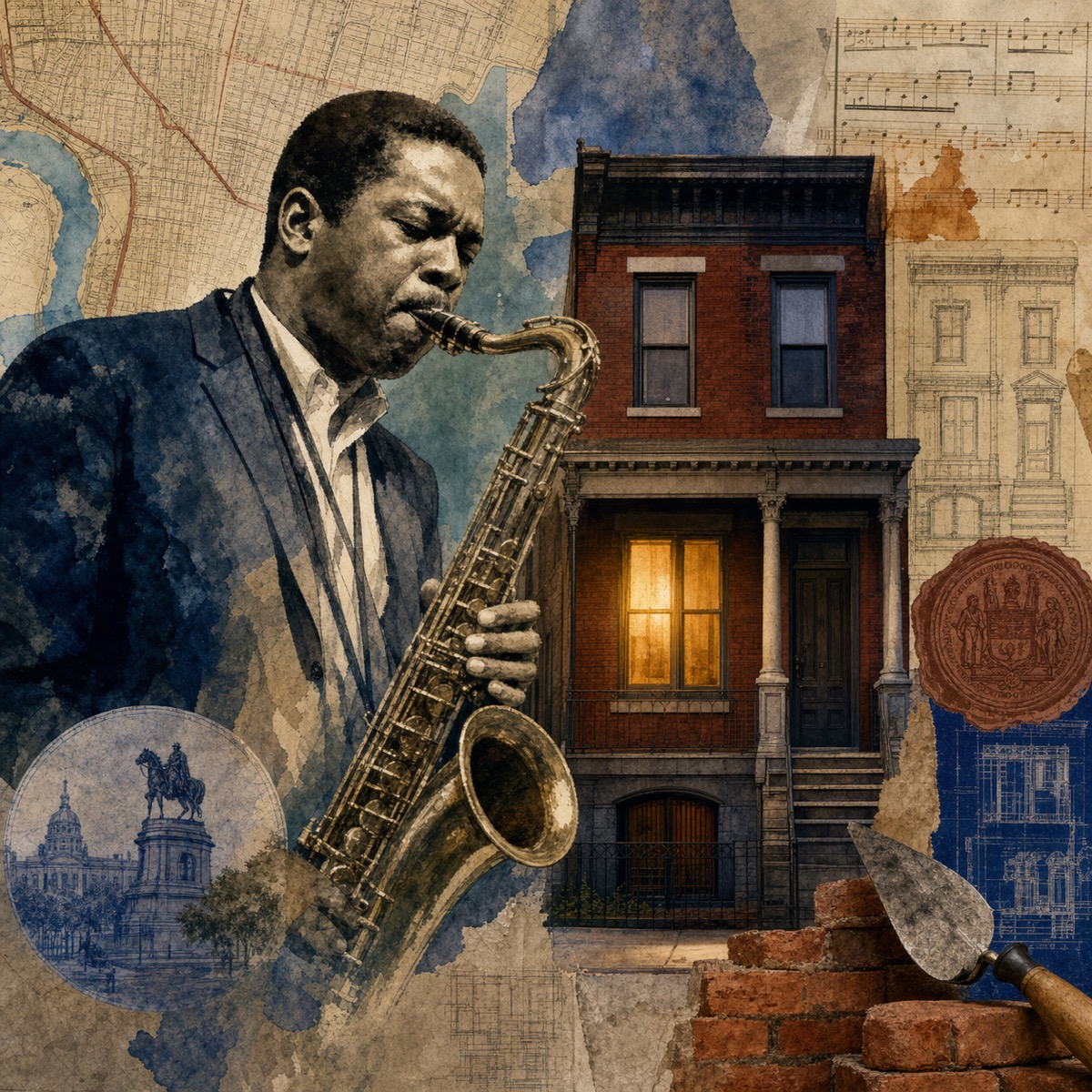
On Philly Tours’ Black American Legacy & Quaker Heritage route, one stop looks like the kind of Philadelphia building you might walk past without a second thought: a brick rowhouse at 1511 N 33rd Street in Strawberry Mansion.
And yet, the city map of American culture runs straight through this address.
The John Coltrane House is recognized as a National Historic Landmark, a top-level federal designation for places with national significance. (National Park Service designation letter, January 20, 1999)
That title matters — but not because it’s a trophy. It matters because it points to a civic question that is alive right now in Philadelphia:
When a neighborhood holds something of national value, what systems keep it standing — and who pays for the care?
The fore-story: genius doesn’t only happen on grand stages
Coltrane’s name can sound like concert halls, record collectors, and museum audio guides. But the house reminds you that artistic revolutions also happen in ordinary rooms — on streets where kids ride bikes, buses run late, and families argue about repairs.
In the 1950s, when Coltrane lived in Strawberry Mansion, North Philadelphia was not simply a backdrop. It was an ecosystem: churches, clubs, stoops, schools, and neighbors who made a life while Philadelphia’s economy and housing patterns shifted under them.
For decades, the Coltrane House was endangered by neglect and uncertainty. In October 2025, WRTI reported that preservation partners were beginning a restoration aimed at bringing the building back as a public-facing cultural site. (WRTI, Oct. 15, 2025)
The civic bridge: preservation is a permit system before it’s a celebration
Philadelphia has no shortage of residents who “support preservation” in the abstract. The hard part is operational: what actually happens when a roof fails, a contractor proposes changes, a developer buys a property, or a neighbor reports deterioration?
Preservation lives inside the machinery of local government:
- building permits and inspections
- zoning and demolition review
- enforcement of property-maintenance rules
- designation processes and public notice
- long timelines where nonprofits assemble financing
If you want a landmark to survive, you need more than admiration. You need clear rules, working procedures, and capacity to enforce them.
That’s why it matters that Philadelphia’s preservation code and process are an active policy subject in 2026 — not a settled museum rulebook.
The current context: Philly is still refining how preservation decisions get made
In spring 2026, Philadelphia City Council considered legislation that would adjust the city’s preservation framework — including procedure and notice requirements tied to the Historic Preservation Ordinance (Philadelphia Code Chapter 14-1000). The related materials include a Historical Commission staff report (April 2026) and the bill text in the City Council’s public legislative system. (City Council bill file: 251030, PHC staff report PDF)
You don’t have to be a preservation specialist to care about what’s in those documents. The point is basic civic governance:
A fair process needs predictable steps that residents can understand, and the city can execute.
That matters for big, famous buildings. It also matters for neighborhood landmarks that don’t have wealthy backers, full-time lawyers, or public-relations teams — the kind of places where history can disappear through delay, confusion, or “nobody realized what was happening until it was too late.”
Why this is also a housing issue — and why that shouldn’t be a fight
In Philadelphia, preservation and housing sometimes get framed as opposites: save the old building or build the new homes.
But the Coltrane House suggests a more practical lens:
Preservation is one way a city decides what kinds of neighborhoods it wants — and who gets to recognize themselves in the landscape.
When a historic home is restored, the city is not just keeping bricks intact. It is deciding that a community’s cultural contribution is worth protecting in the same city that is trying to expand housing supply, reduce vacancy, and keep long-term residents from being priced out.
The best version of this policy conversation isn’t “preserve everything” or “bulldoze everything.” It’s:
- preserve what is truly meaningful (especially where history has been undervalued)
- make the rules legible and enforceable
- pair preservation with housing strategy so neighborhoods aren’t treated as disposable
For a landmark like the Coltrane House, that can mean treating a restored site as a neighborhood anchor: arts education, community programming, and local jobs tied to maintenance and operations — not only a ribbon-cutting.
A reader takeaway: public memory needs maintenance, like streets and schools do
American civic life runs on institutions that aren’t glamorous:
- codes
- notices
- hearings
- budgets
- inspections
- procurement
Those systems can feel slow and frustrating. But they’re also how a city makes fairness possible at scale — especially for residents who don’t have personal access to decision-makers.
The Coltrane House is a reminder that the “how” of government is where history is either protected or lost. A federal designation alone won’t stop water damage. A heartfelt speech won’t replace a roof. The work is local, procedural, and sustained.
Route connection: visit the stop, then read the city like a score
If you visit the John Coltrane House stop on Philly Tours, try a two-part exercise:
1. Stand on North 33rd Street and picture how much American culture can come from one block — from a home, a family, and a neighborhood. 2. Then follow today’s civic paper trail: how preservation decisions are documented in public.
Start here:
- WRTI’s restoration reporting for what stewardship looks like on the ground. (WRTI, Oct. 15, 2025)
- Philadelphia City Council’s public bill file for how preservation policy gets tuned in real time. (Bill 251030)
In a city, history isn’t only what happened. It’s what we decide to keep making possible — by keeping the places that shaped us in the shared landscape.