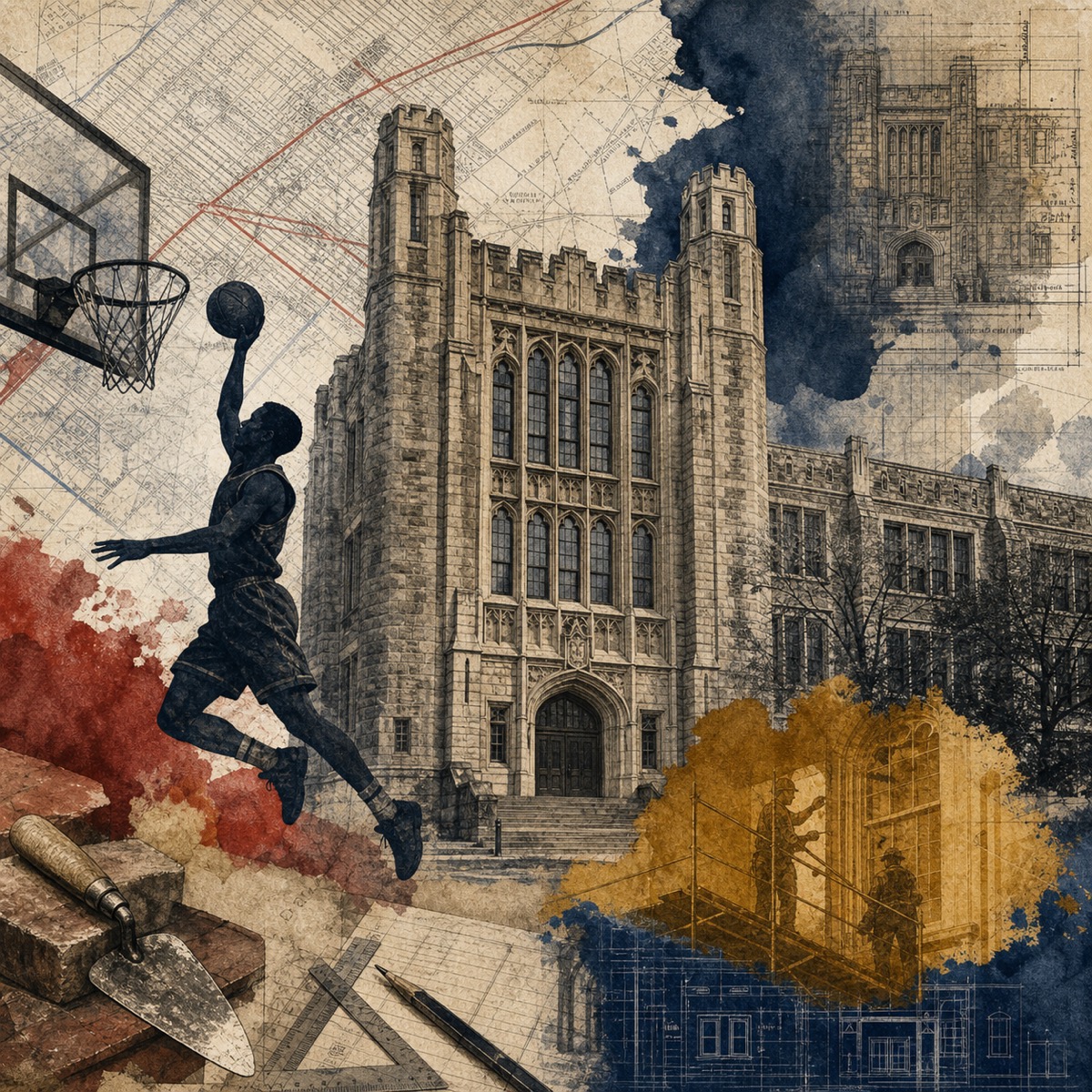
On the Philly Tours Black American Sports route, one stop is a reminder that American history is not only written in capitols and courtrooms. Sometimes it is written in a public-school hallway.
Overbrook High School, on Lancaster Avenue in West Philadelphia, opened in the 1920s and is still often described as “the Castle on the Hill.” The building itself is part of the story: a civic institution meant to last, built at a time when cities treated public schools as permanent infrastructure. (Overbrook High School (Philadelphia)))
Overbrook is also a sports landmark. Most famously, it is tied to Wilt Chamberlain, a local phenomenon whose high-school years helped make Philadelphia a national basketball city before he became an NBA icon. (Wilt Chamberlain)
But the deeper point of visiting Overbrook isn’t nostalgia. It’s that the place where a legend is made is also the place where thousands of other students learn what their city thinks they deserve.
The fore-story: when a public school is a city’s promise
Overbrook’s history sits in a familiar American pattern: build a school meant to last, then do the hard, ongoing work of staffing it and keeping it safe and functional as the city changes.
When we talk about a school “producing” someone like Chamberlain, we’re talking about more than a gym. We’re talking about an ecosystem—coaches, teachers, transportation, after-school supervision, and the unglamorous basics (lights that work, safe drinking water, classrooms without leaks).
That is why a stop like Overbrook belongs in a civic-history blog. Public schools aren’t just service providers. They are one of the most concrete ways Americans experience democracy: through budgets, building decisions, and the daily reality of what is available to kids.
The civic bridge: school buildings are public infrastructure
It’s easy to treat school buildings as background—something you notice only when it fails. But buildings shape learning.
A building that is too hot or too cold becomes a concentration problem. A building that needs major repairs becomes a scheduling problem. A building that can’t support modern labs or career-and-technical programs becomes an opportunity problem.
The current context in 2026: Philadelphia is debating a ten-year facilities overhaul
In 2026, the School District of Philadelphia has been wrestling with a major facilities blueprint—a ten-year plan that combines modernization with school closures and mergers. Coverage of the plan has described a multibillion-dollar price tag and a reality that the district will need substantial outside funding to carry it out. (Axios Philadelphia: updated facilities plan; CBS Philadelphia: facilities plan overview; Axios Philadelphia: funding and alternate plans)
The civic tension is unavoidable:
- If you keep every building open, you may spread limited capital money too thin.
- If you close buildings, you may break neighborhood trust and create longer commutes.
- If you only modernize some schools, you risk deepening inequality between “fixed” and “unfixed” campuses.
Pennsylvania’s role: adequacy funding, not just local effort
Facilities are local, but the money system is statewide.
Pennsylvania’s public-school funding debates have been shaped by the Commonwealth Court’s 2023 ruling that the state’s school-funding system is unconstitutional and must be reformed. (AP: Pennsylvania school funding ruled unconstitutional; Education Law Center (PA): case background)
Against that backdrop, Governor Josh Shapiro’s proposed FY 2026–27 budget includes a $50 million increase to the Basic Education Funding appropriation, according to the Pennsylvania Department of Education’s budget summary page. (PA Department of Education: Education Budget)
At the same time, policy and advocacy groups tracking “adequacy” investments argue that the real question is scale: whether annual increases are large enough, and targeted enough, to move Pennsylvania toward constitutional compliance and reduce resource gaps across districts. (Pennsylvania Policy Center: education funding in FY 2026–27 proposal; PA Schools Work: statement on FY 2026–27 budget proposal)
This is the bridge back to Overbrook: a city can make smart local choices, but if the state’s funding system remains unstable or inequitable, “modernize the schools” becomes a promise that communities hear repeatedly—and see delivered unevenly.
What Overbrook teaches now: opportunity is built, maintained, and renewed
Overbrook’s sports legacy is often told as individual excellence. Chamberlain’s dominance becomes the whole plot.
But a public-school institution is the opposite of a solo story. Its real legacy is cumulative: mentors, classrooms that support focus and safety, access to arts and labs, and the practical ability to stay after school.
That is why facilities and funding aren’t “inside baseball.” They are how a city decides whether talent is rare—or whether it is common, and simply needs rooms, time, and adults who are supported enough to teach.
Overbrook also offers a caution: when maintenance is deferred and buildings age without reinvestment, the school’s public meaning can change. What was built as a durable promise can start to feel like a bargain the city is quietly walking away from.
Route connection: visit Overbrook, then look for the budget behind the building
When you visit Overbrook High School on the Philly Tours Black American Sports route (near 5898 Lancaster Ave), start by looking up at the building’s scale and permanence.
Then ask a civic question that goes beyond sports:
What would it take—this year and every year—to keep a public school like this safe, modern, and worthy of the kids who walk in?
That question is on the agenda in 2026, from the School District’s facilities master plan to Harrisburg’s adequacy-funding debates. Overbrook’s history suggests a simple takeaway: if a city wants “the next Wilt,” it has to fund the everyday institution that makes greatness possible.