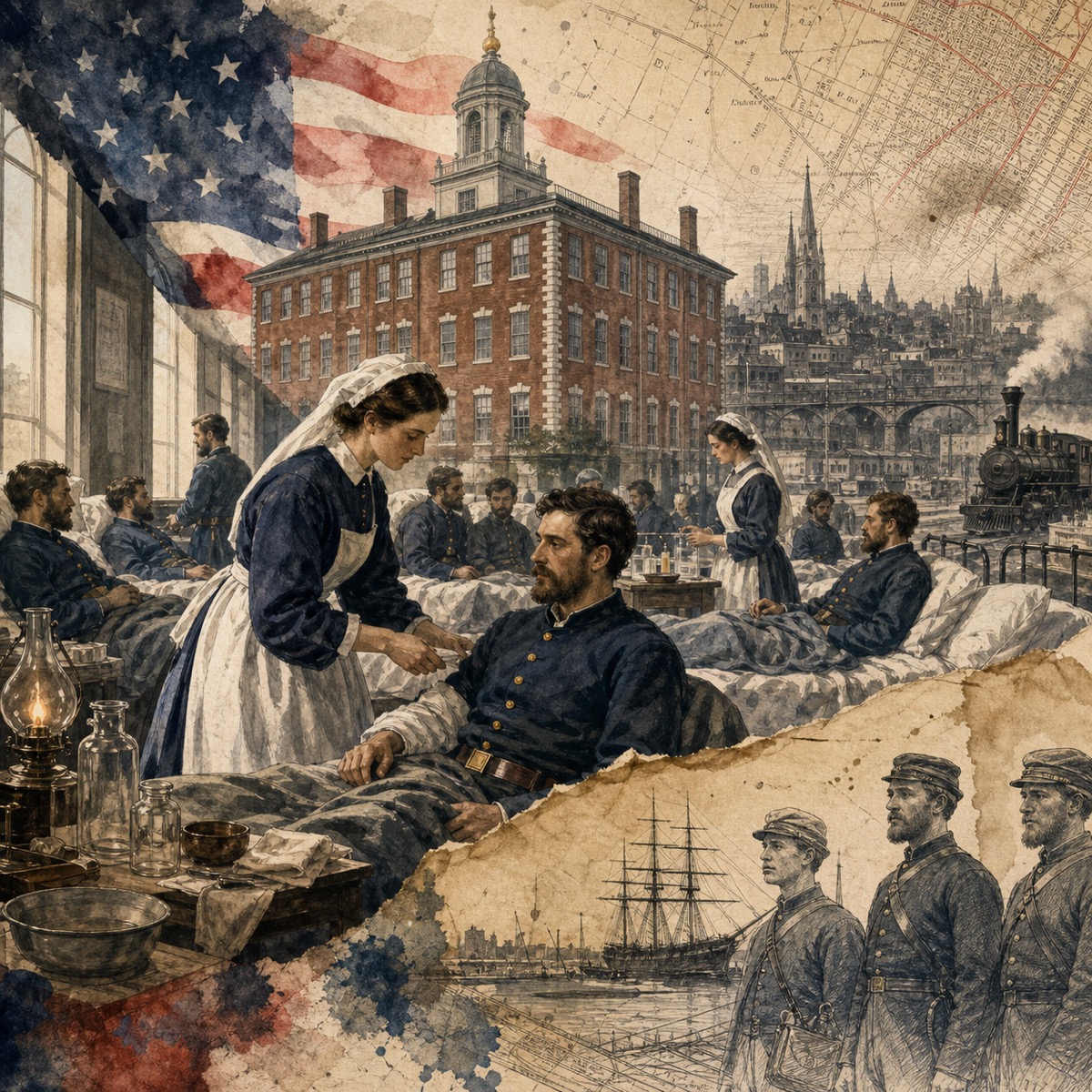
Philadelphia's Civil War story is not a battlefield story. No major battle was fought in the city itself. But that can make the city's role easier to misunderstand.
The Union did not survive only because armies met on fields. It survived because cities could recruit, manufacture, transport, heal, feed, fund, and organize. Philadelphia became one of those indispensable home-front cities. It supplied soldiers and officers, moved men and material through its rail network, raised money for relief, supported the United States Colored Troops, and cared for the wounded when the war came back north in bodies rather than cannon fire.
That kind of civic work can look quiet from a distance. Up close, it is the difference between a nation with ideals and a nation with enough systems to defend them.
The city that fought by organizing
Philadelphia sent a staggering number of people into Union service. The American Battlefield Trust notes that almost 100,000 Philadelphians served in the Union Army between 1861 and 1865, roughly three quarters of the city's male population. The Encyclopedia of Greater Philadelphia gives the city figure as 93,300, with the surrounding counties bringing the regional total above 100,000. (American Battlefield Trust on Philadelphia during the Civil War; Encyclopedia of Greater Philadelphia on the Civil War)
The city also produced and supported military leadership. George G. Meade, remembered as the Union commander at Gettysburg, was a Philadelphian and is buried at Laurel Hill Cemetery. George B. McClellan, another major Union general, was born in Philadelphia. Their names can make the story feel like a list of famous men, but the deeper lesson is institutional: Philadelphia was a place where military service, politics, medicine, manufacturing, transportation, and civic association overlapped.
The Union League, founded in Philadelphia in 1862, worked to counter anti-war politics and support the Union cause. The Frankford Arsenal supplied munitions. The Navy Yard built and repaired warships. Railroads moved soldiers and materiel. Relief groups and refreshment saloons helped troops passing through the city. Philadelphia's power was not one thing. It was a network.
The hospitals were part of the war effort
The most human part of that network was medical care.
By the end of the war, Philadelphia alone had twenty-four military hospitals that treated more than 150,000 soldiers, according to the Encyclopedia of Greater Philadelphia. These were not symbolic institutions. They were working systems, built under pressure, staffed by doctors, nurses, volunteers, administrators, cooks, laundresses, orderlies, and others whose labor made survival possible.
Satterlee General Hospital in West Philadelphia became one of the largest military hospitals in the North. McClellan Hospital in Nicetown had more than one thousand beds arranged in pavilions designed for ventilation. Smaller hospitals and relief sites formed an emergency care landscape across the city. When wounded and sick soldiers arrived from the front, Philadelphia became a place where the war's cost was counted in fever, infection, amputation, recovery, grief, and return.
It is easy to say "medical hub" and move on. But every bed required logistics: linen, food, heat, water, records, medicines, transport, staffing, sanitation, and communication. A hospital is not just a building. It is a promise made operational.
The bridge to now: readiness before the emergency
That is where the Civil War home front connects to 2026 Philadelphia.
Modern emergency preparedness uses different language: hazard mitigation, health care coalitions, public health preparedness, incident information, mass-care planning, exercises, and after-action reports. But the basic civic question is the same one Civil War Philadelphia had to answer: what capacity does a city build before the emergency tests it?
Philadelphia's Office of Emergency Management says its work includes planning for large-scale emergencies and disasters, conducting exercises, coordinating responses, and obtaining preparedness funding for the city. In May 2026, the office was already posting public safety information for FIFA World Cup 2026 Philadelphia, a reminder that large events are also stress tests for transportation, communications, health care, and crowd safety. (City of Philadelphia Office of Emergency Management)
At the state level, Pennsylvania's Department of Health frames public health preparedness as a duty that continues during disasters and emergencies, with coordination among local, state, federal, private, hospital, and health care partners. At the federal level, ASPR's Hospital Preparedness Program describes itself as a source of leadership and funding to help health care systems plan for and respond to large-scale emergencies and disasters. (Pennsylvania Department of Health public health preparedness; ASPR Hospital Preparedness Program)
That language may sound bureaucratic, but it describes something very concrete. When a city faces a mass casualty incident, heat emergency, building collapse, infectious disease threat, flood, transit disruption, or major public event, readiness is not improvised from goodwill alone. It depends on plans, trained people, stocked supplies, interoperable communications, transportation routes, mutual-aid agreements, accessible alerts, and trust.
Civil War Philadelphia shows why that matters. The city did not become useful to the Union by accident. It had institutions that could be redirected, expanded, and connected.
The reader takeaway: civic infrastructure includes care
One trap in public memory is to treat "the home front" as secondary, as if real history only happens where shots are fired. Philadelphia's Civil War record argues the opposite.
Recruitment mattered. Industry mattered. Rail mattered. Medical care mattered. Public persuasion mattered. Black military service mattered. Women's relief work mattered. The city became part of the Union war effort because ordinary civic systems were asked to do extraordinary work.
That should change how we think about preparedness now. A hospital bed is not only a health care asset. A working alert system is not only a tech tool. A volunteer registry is not only a sign-up form. A public drill is not only a calendar item. These are pieces of civic infrastructure, and they are easiest to undervalue before they are needed.
The Civil War did not ask Philadelphia whether it was emotionally committed to the Union. It asked whether the city could recruit, supply, transport, treat, and endure. Every emergency asks a version of the same question.
The Philly Tours connection: Pennsylvania Hospital and the Union League
On Philly Tours, two stops help bring this story back to the street.
Pennsylvania Hospital appears on the Black Medical Legacy route and the Masonic Scavenger Hunt. Its longer history reaches before and after the Civil War, but it is a strong place to talk about Philadelphia as a medical city and about the complicated relationship between care, science, race, power, and public responsibility.
The Union League appears on the Black Architects Tour. The building's later architectural history belongs to that route, but the institution itself was born from Civil War politics, when Philadelphia elites organized to defend the Union cause and support recruitment.
Together, these stops invite a different kind of sightseeing. Look at the city not only for monuments and facades, but for systems: hospitals, rail corridors, civic associations, volunteer networks, public agencies, and the people who keep them working.
Philadelphia's Civil War lesson is not that every emergency resembles a war. It is that public survival depends on capacities built in advance. A city that wants to be resilient has to practice care before the sirens start.