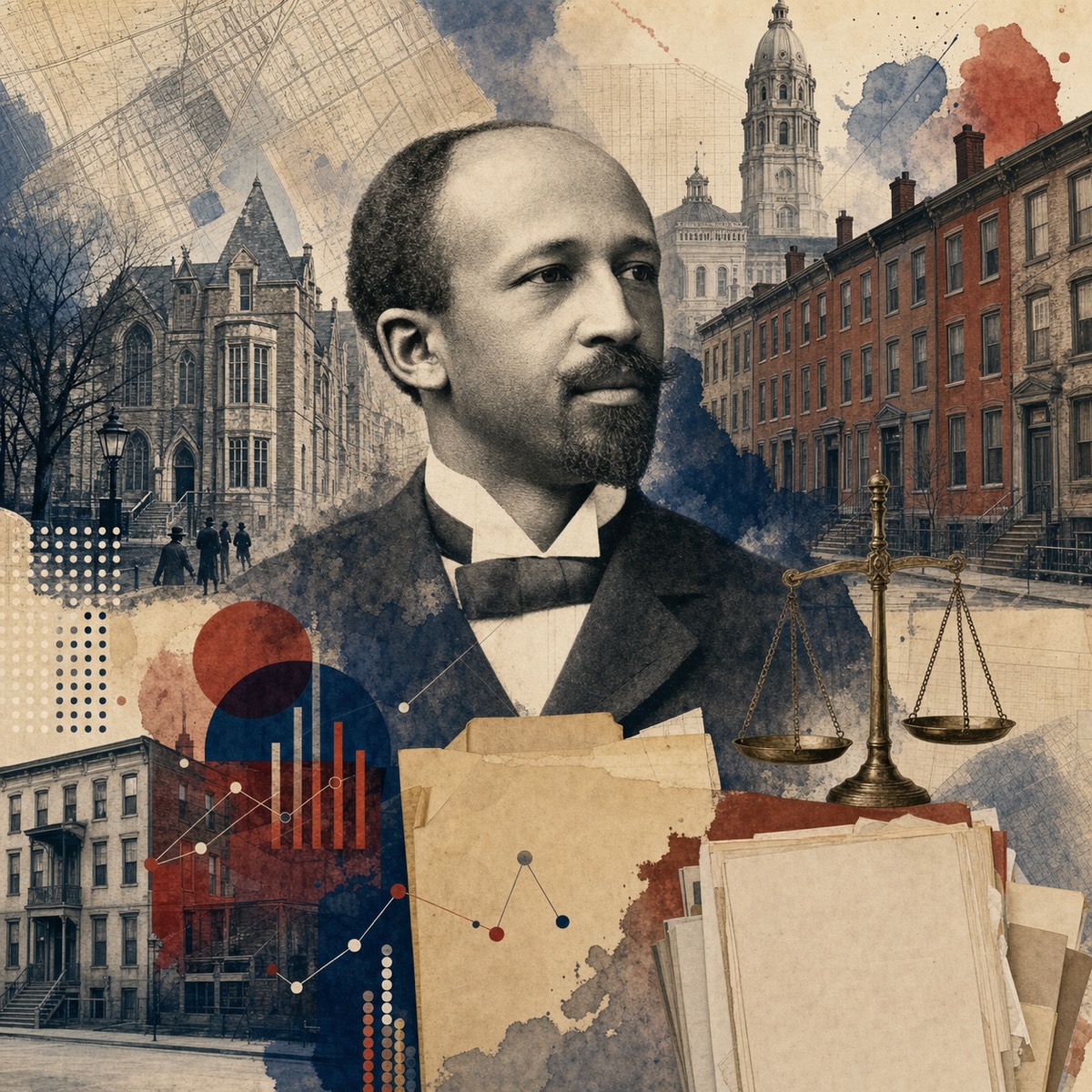
In 1896, a 28-year-old sociologist walked Philadelphia with a notebook and a map and tried to answer a civic question that still haunts American cities: what happens when a neighborhood’s housing, jobs, schools, and public services are structured to produce inequality—and then we treat the results as personal failure?
That researcher was W.E.B. Du Bois, and the project became The Philadelphia Negro (1899), one of the earliest large-scale, data-driven studies of urban life in the United States. Du Bois did not write about “poverty” as a vague moral category. He counted, interviewed, charted, and mapped. He treated policy as something you could see on a block and measure over time.
Philadelphia is now living inside a modern version of his question. Over the past few years, the city has invested in an eviction-prevention system that includes a Right to Counsel program—publicly funded legal representation for eligible renters facing eviction in covered ZIP codes. The most practical civic claim behind that investment is simple: if legal help changes outcomes in court, then housing stability is not only a private matter. It is public infrastructure.
Du Bois’ Philadelphia: a study of a city’s system, not a person’s choices
Du Bois came to Philadelphia to study the Seventh Ward, an area west of Broad Street that included a large Black community and intense economic stratification. His method was both intimate and structural: door-to-door household surveys, institutional records, neighborhood observation, and careful attention to how discrimination and labor markets shaped what families could afford and where they could live.
One reason The Philadelphia Negro still matters is that Du Bois refused the story a city often tells itself when inequality becomes visible: that the “problem” is the people. He argued instead that housing conditions, employment exclusion, and political power were entwined—and that the city could not understand its present without acknowledging how its institutions distributed opportunity and risk.
That framing is also a warning about civic memory. A city can remember famous buildings and forget the policy choices that governed who could safely live near them. Du Bois’ work pushes against that kind of selective nostalgia. It forces a harder civic accounting: if the public structures create predictable harm, then fixing it is also a public responsibility.
The bridge: eviction court is where housing policy becomes real
Eviction is sometimes described like a single event—a notice, a court date, a lockout. But eviction systems function more like pipelines. They sort people by income, credit, and legal knowledge. They reward those who can navigate paperwork and deadlines. They punish instability with more instability.
That is why “access to counsel” has become a major U.S. housing policy lever. In most landlord-tenant courts, landlords are far more likely than tenants to have a lawyer. When one side routinely brings representation and the other routinely does not, the courtroom is not a neutral venue. It is a predictable machine.
Philadelphia has tried to interrupt that machine with a bundled approach: an Eviction Diversion Program designed to resolve disputes and connect households to financial help before a case proceeds, and a Right to Counsel initiative designed to increase the share of tenants who have a lawyer in high-need communities.
This is exactly the kind of city-scale experiment Du Bois would recognize: a policy intervention that can be tracked, mapped, and evaluated—not just argued about.
What changed recently: Right to Counsel expanded, and the city published outcomes
Philadelphia’s FY2025 Right to Counsel annual report documents the program’s fourth year (July 1, 2024 through June 30, 2025) and notes that it expanded into additional ZIP codes (19124, 19141, and 19154). The report also describes Right to Counsel as part of the broader Philadelphia Eviction Prevention Project, delivered by partner legal organizations and connected to tenants through proactive outreach. (City of Philadelphia: Right to Counsel FY2025 annual report PDF)
The same report includes a blunt metric that matters in any court system: defaults. In covered ZIP codes during FY2025, unrepresented tenants experienced far more default judgments than tenants represented by Philadelphia Eviction Prevention Project partners, while represented tenants were far more likely to resolve cases through agreements rather than losing by default. In other words: having a lawyer changes the shape of outcomes, not just the feelings people bring into the room. (City of Philadelphia: Right to Counsel FY2025 annual report PDF)
At the same time, eviction filing data is publicly trackable. Eviction Lab’s Philadelphia dashboard and the Legal Services Corporation’s Civil Court Data Initiative provide ongoing, month-by-month visibility into filings. Those data sources matter because they make the debate less abstract: the city can argue about philosophy, but it can also track whether filings rise, fall, or concentrate in particular neighborhoods. (Eviction Lab: Philadelphia eviction tracking, LSC Civil Court Data: Philadelphia County eviction filings)
One practical takeaway from these sources is that Philadelphia’s policy choices can be evaluated the way Du Bois evaluated city life: by changes in rates, disparities, and neighborhood patterns—not by anecdotes alone.
What to notice on the Philly Tours route
On Philly Tours’ Black American Legacy & Quaker Heritage route, the W.E.B. Du Bois College House stop (3900 Walnut St.) is a reminder that Philadelphia’s civic story is not only founders and monuments. It is also the city as a living dataset: households, blocks, rents, jobs, transit lines, schools, and courts.
At that stop, think about the kind of work Du Bois did: patient, empirical, and morally serious without being preachy. Then connect it to the modern policy question Philadelphia is now testing in real time. When a city funds lawyers for tenants and builds diversion pathways before cases escalate, it is making a claim that resembles Du Bois’ most enduring insight:
If the city helped build the conditions that produce instability, the city can also build conditions that produce stability.
If you want to see how that idea lives in place, the walk from West Philadelphia’s university blocks toward the city’s institutions is the point. Du Bois’ Philadelphia was never only “history.” It was a blueprint for how a democracy learns from its own evidence.