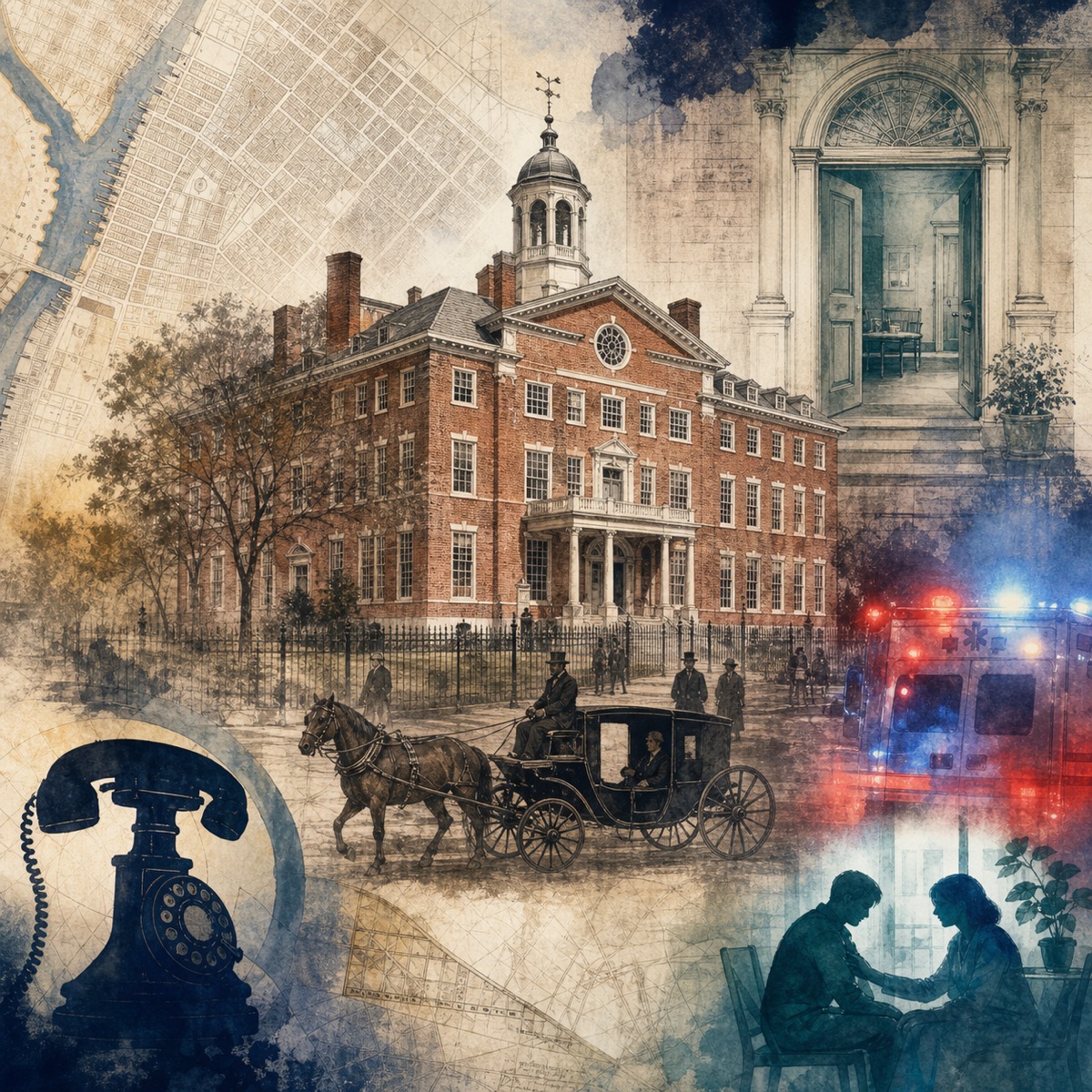
On Philly Tours’ Black Medical Legacy route, one stop is Pennsylvania Hospital at 800 Spruce Street. The building reads like a monument to “firsts”—but its most relevant first may be a quieter one: it helped Philadelphia invent the idea that a city has an obligation to receive people in crisis, including mental-health crisis, rather than leaving them to fend for themselves.
That obligation is being tested again in 2026. Pennsylvania is trying to strengthen its 988 Suicide & Crisis Lifeline system and the broader crisis-care network around it—the human beings, vans, rooms, and beds that make “call for help” turn into “help arrived.” The problem is not only whether people can reach someone on the line. It is whether the public has built a place for the crisis to land.
The fore-story: a hospital built for the “sick-poor and the insane”
Pennsylvania Hospital was founded in 1751 as a charitable institution for the “sick-poor and the insane,” a formulation that sounds archaic but points to a civic decision: illness and mental distress were not only private burdens; they were public responsibilities. (Pennsylvania Hospital’s own historical timeline and collections describe this early scope.) (Penn Medicine Archives: Institute of Pennsylvania Hospital—general history)
By the early 19th century, Philadelphia’s leaders faced an operational reality that every crisis system eventually hits: people who need care do not arrive in neat categories. A general hospital ward is not automatically a therapeutic place for someone in acute psychiatric distress. Overcrowding, noise, and stigma collided with the era’s limited medical tools.
So in 1841, Pennsylvania Hospital opened a separate facility for mental illness in West Philadelphia—originally called the Pennsylvania Hospital for the Insane—and began transferring patients there. Penn’s archives describe nearly 100 patients moving by carriage from 8th and Spruce to the new rural site that winter. (Penn Medicine Archives: 1841 move to the new hospital)
This wasn’t only a building project. It was a theory of public care: the city needed a dedicated, properly resourced receiving system for mental-health emergencies—staff, space, and routines designed for crisis, not improvised in a hallway. Even if many 19th-century psychiatric practices were flawed by today’s standards, the infrastructure lesson holds: a humane response requires somewhere appropriate to bring people.
The civic bridge: crisis care is an infrastructure problem
Fast-forward to the modern emergency department. If you want to know whether a region has enough mental-health capacity, look at where people wait when capacity runs out. Across the country, hospitals report long “boarding” periods—patients in psychiatric crisis stuck in EDs because there is nowhere else to go.
Emergency physicians have been blunt about the consequences. The American College of Emergency Physicians describes boarding of psychiatric patients as inhumane and a symptom of system-wide underinvestment, and it has urged policy changes to address ED boarding. (ACEP press release on boarding and psychiatric patients)
This is where Pennsylvania Hospital’s 1841 pivot becomes more than trivia. The historic question—what happens after the moment of crisis?—is also the central question of today’s 988 rollout.
Current context: “someone to call, someone to respond, and somewhere to go”
The national 988 system is designed to make help easier to reach. SAMHSA describes 988 as part of building a transformed crisis-care system that links people to community-based supports. (SAMHSA: 988 Suicide & Crisis Lifeline)
But 988 is only the “someone to call.” For the system to work as intended, it also needs “someone to respond” (like mobile crisis teams) and “somewhere to go” (like stabilization centers, short-stay units, and inpatient care when needed).
In Pennsylvania, that full-stack approach has become explicit policy language. A recent Commonwealth announcement about the governor’s 2026–27 proposed budget frames crisis care as a three-part system—someone to call, someone to respond, and somewhere to go—and says the proposal includes $10 million in dedicated state funding for 988 operations. (PA press release: proposed 988 investment)
The Department of Human Services budget materials add a useful operational detail: Pennsylvania has fourteen 988 call centers, and the proposed budget describes $10 million for crisis line operations and capacity building. (PA DHS Blue Book 2026–27)
Those details matter for Philly because “capacity” isn’t abstract. It’s staffing levels that keep calls answered in-state. It’s follow-up protocols. It’s whether a mobile team can arrive quickly enough to keep someone out of an ambulance. And it’s whether a person who is unsafe at home has an alternative to spending the night in an emergency department that was never built for psychiatric care.
What Pennsylvania Hospital’s story teaches in 2026
The easy story about Pennsylvania Hospital is “America’s first hospital.” The more useful story is that Philadelphia has repeatedly had to choose where it will put suffering when private life can’t hold it.
In the 1700s, the choice was to build a charitable hospital at all. In 1841, it was to admit that “general care” and “crisis psychiatric care” are not the same thing—and to build a place that claimed to be better suited to the second.
Today’s version of that decision isn’t about carriages moving to a rural campus. It’s about whether we fund the less visible parts of crisis response: call-center staff retention, mobile response coverage, and the brick-and-mortar “somewhere to go” that makes diversion from the ED possible.
If 988 is treated as a hotline alone, people will still land where systems always default: the ER, the police station, the sidewalk, or a family’s living room at 3 a.m. If 988 is treated as public infrastructure, it can function more like what Pennsylvania Hospital tried to become: a civic promise that in the worst hour, the city will still have a door.
Route connection: see the question on the street
When you visit Pennsylvania Hospital on Philly Tours, stand at 8th and Spruce and imagine the city in two frames at once: the 1751 decision to build a public place for care, and the 1841 decision to build a distinct receiving system for mental illness. Then bring it back to today: what does Philadelphia want its crisis-care “receiving system” to be—an overloaded emergency department, or a network designed for dignity?
If you’ve ever wondered what “policy” looks like in real life, this is it: not a bill title, but a place where someone can be brought, safely, when everything else is falling apart.