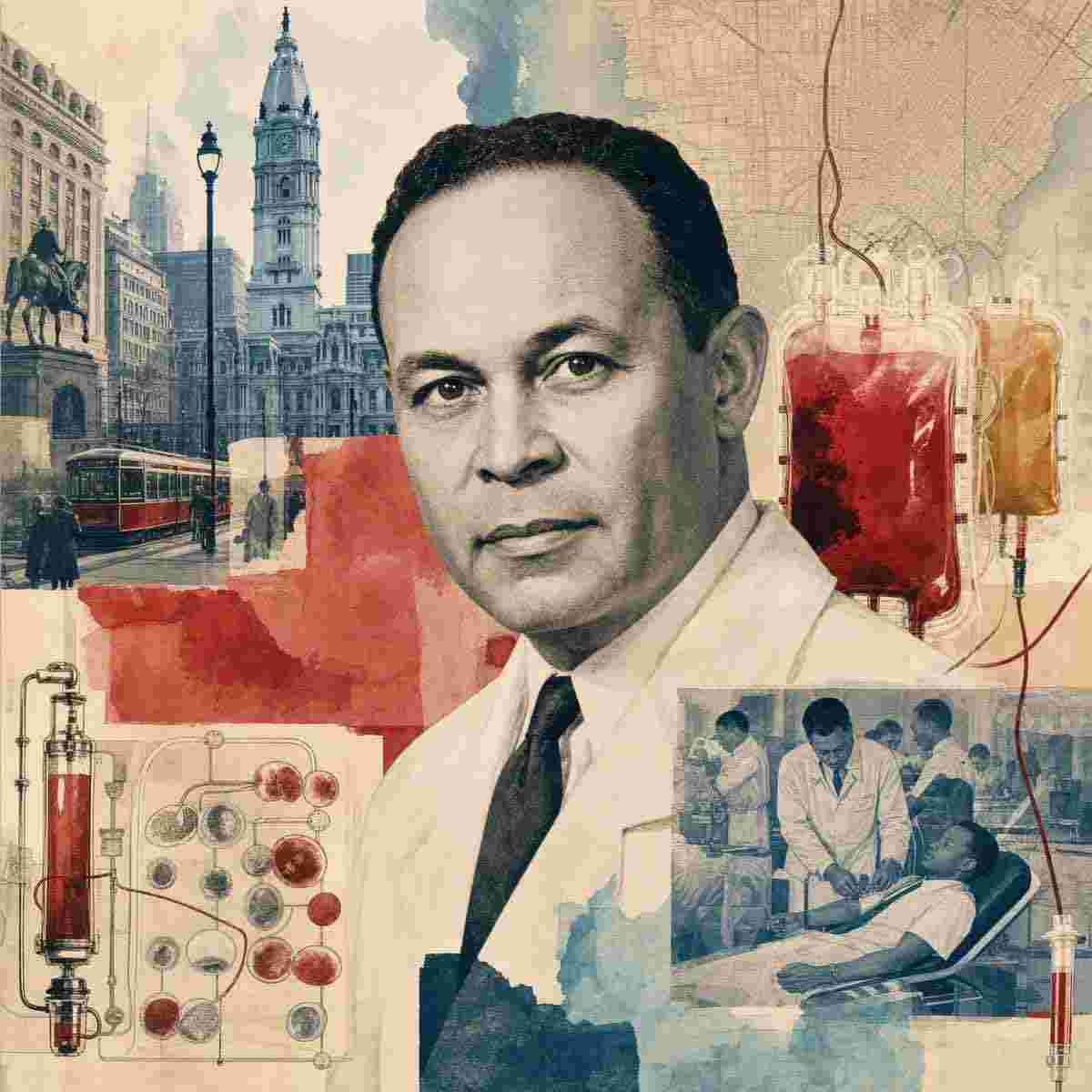
When we talk about “infrastructure,” we usually picture bridges, water mains, or power lines. But there’s another system that quietly keeps cities alive: the blood supply.
Philadelphia has a stop in the Philly Tours route database that makes that invisible system visible: the Dr. Charles Drew Blood Bank on the Black Inventors Tour. Drew’s work did not just improve a medical technique; it helped define how the United States would treat blood as a public resource—collected from neighbors, stored safely, moved quickly, and rationed carefully when the system is under stress.
The fore-story: a doctor who organized a national resource
Charles R. Drew trained as a surgeon, but his lasting impact came from a systems problem: how do you preserve blood long enough to use it when and where it’s needed? In the late 1930s and early 1940s, Drew’s research and leadership helped standardize practices for collecting, processing, and storing blood and plasma at scale—work that became central to wartime and civilian medicine. The National Library of Medicine’s Profiles in Science collection shows how Drew’s blood preservation research and program-building contributed to modern blood banking. NLM: “Becoming ‘the Father of the Blood Bank,’ 1938–1941”
That phrase—blood bank—is deceptively ordinary now. But it describes a major civic leap: instead of treating blood as something handled ad hoc in an operating room, a blood bank treats it like a shared reserve that can be planned for, quality-controlled, transported, and deployed. In other words, Drew helped move lifesaving transfusions from improvisation to infrastructure.
There’s another layer to Drew’s legacy that matters in Philadelphia today: blood banking works only when the public trusts the system enough to participate. A safe blood supply depends on a chain of public cooperation—donors, collection staff, lab testing, storage standards, hospital inventory management, and transportation. When any part of that chain falters, the whole system tightens.
The civic bridge: blood isn’t just “medical”—it’s logistical
Drew’s story gives us a useful way to reframe a modern headline: blood shortages aren’t only hospital problems. They’re city problems. When the supply drops, hospitals postpone certain surgeries, triage limited units, and concentrate resources on trauma care, cancer treatments, complicated births, and chronic conditions that require regular transfusions.
Unlike many medical supplies, blood can’t be “manufactured” on demand. It comes from people, has shelf-life limits, and must be processed and tested before it reaches hospitals—so a shortage is rarely solved in a weekend.
Current context: a recent nationwide shortage warning (and what it implies locally)
In January 2026, the American Red Cross publicly declared a severe blood shortage, reporting that the national blood supply had fallen by roughly 35% over the previous month. AHA News summary of the Red Cross announcement
That kind of drop is an indicator that the system is running too close to the edge—especially during months when weather cancels drives and seasonal illness reduces donors.
Shortages also cascade. AABB, America’s Blood Centers, and the American Red Cross issued a joint statement in January 2026 urging donors to give blood as severe winter weather threatened to further disrupt collections. Joint statement (PDF)
For Philadelphia-area residents, these national alerts matter because our region’s hospitals are connected to the same national collection, testing, and distribution networks. The “blood supply” is not a warehouse sitting under one hospital; it’s a coordinated system that must be continuously replenished.
So what’s the civic question? It’s the same one Drew faced, translated into today’s constraints: how do we design a blood system that can handle predictable disruptions without becoming brittle?
Policy levers without culture-war heat: how rules and capacity shape supply
One important lever is donor eligibility policy, which must balance inclusion, safety, and speed. In May 2023, the U.S. Food and Drug Administration finalized guidance recommending an individual risk-based approach to donor eligibility questions aimed at reducing the risk of HIV transmission by blood and blood products. FDA guidance (May 2023)
If screening is too blunt, a community loses willing, safe donors; if it’s too lax, recipients face avoidable risk and public trust erodes. Another lever is capacity and redundancy—when collection sites are scarce or staffing limits appointments, supply becomes fragile.
Reader takeaway: what Drew teaches about civic life now
Dr. Charles Drew’s contribution wasn’t only scientific. It was civic: he helped turn a lifesaving practice into an organized public resource. That matters now because blood shortages reveal a hard truth about modern life in a big city: we depend on shared systems that function only when people participate.
If you want a concrete civic action that doesn’t require a rally or a vote, blood donation is one of the clearest. It’s also a reminder that “public health” includes logistics, staffing, and trust—not just medicine.
And there’s a deeper lesson, especially in Philadelphia: resilience is built before a crisis. When winter storms, outbreaks, or staffing disruptions hit, the blood supply doesn’t start from scratch—it reveals how well (or how narrowly) we built the system in calmer months.
Route connection: the Drew stop as a lens on modern resilience
On the Philly Tours Black Inventors Tour, the Dr. Charles Drew Blood Bank stop is an invitation to see an essential civic system that’s usually invisible. Use it as a prompt to think like a systems builder:
- Where does blood come from in a city—and who has access to donate?
- How do standards, testing, and storage protect recipients and trust?
- What happens when weather, illness, or staffing squeezes the supply?
Drew’s story is a Philadelphia-friendly way to talk about a national problem without cynicism. It’s a reminder that the most human kind of infrastructure is the kind that literally moves from neighbor to neighbor—and that needs steady civic maintenance to keep working.