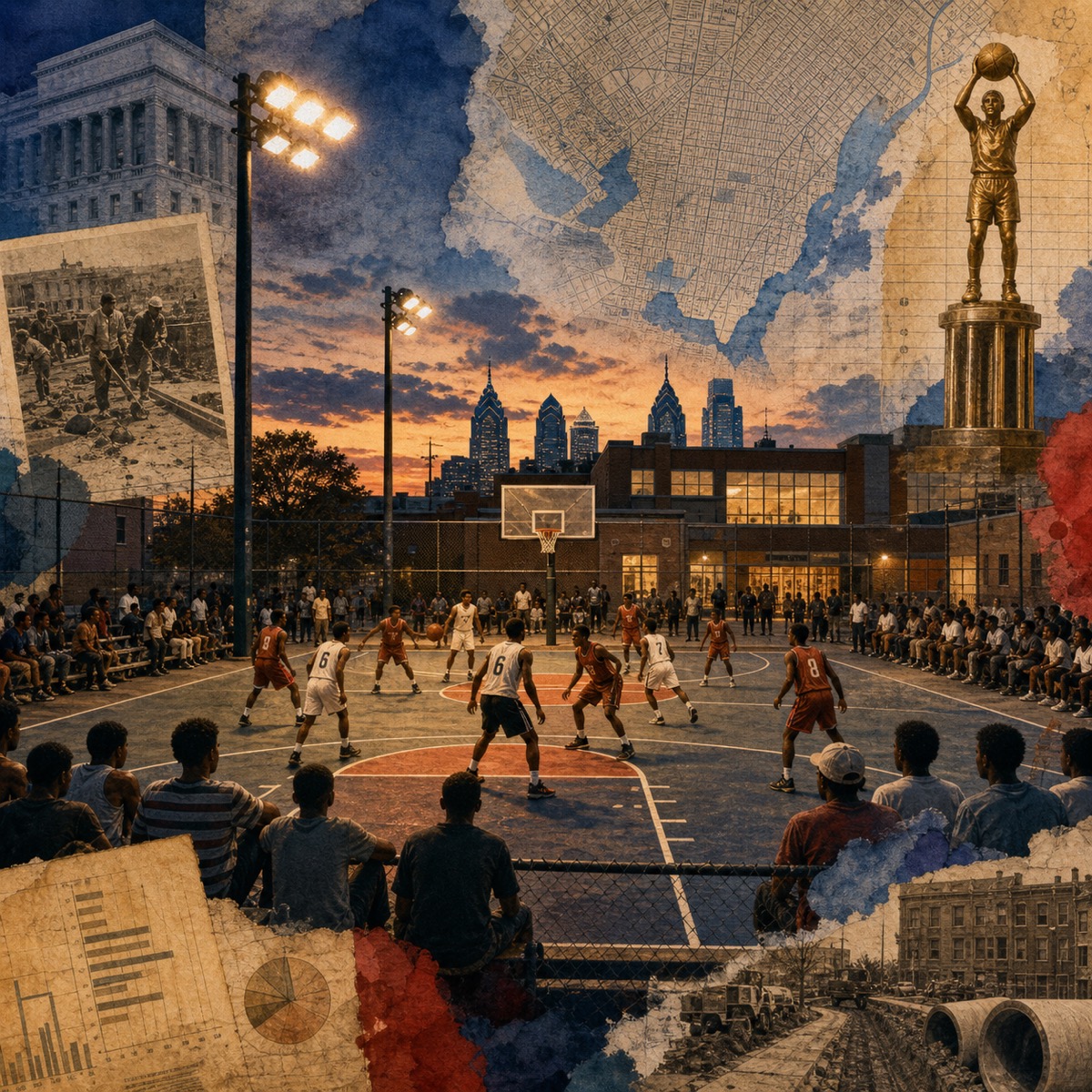
On a summer night in Philadelphia, a basketball court can feel like a whole city in miniature. There’s the visible part—ballhandlers, benches, the scoreboard glow—and then there’s the invisible part: lights that work, lines painted clearly, gates that open on time, and staff who can defuse tension before it becomes a crisis.
That hidden layer is why the story of the Sonny Hill League is more than a sports story. It’s a public-life story—about how a neighborhood uses a public space to build opportunity, safety, and a sense of belonging.
A summer league as a civic institution
The Sonny Hill Community Involvement League is often described with the language of basketball greatness: future pros passing through, packed sidelines, the feeling that something important is happening on the blacktop. But the point of the league was never only talent evaluation. Sonny Hill built it as a structured, supervised space for young people, shaped by the idea that community life can be organized—on purpose—against the pull of disorder. (For a contemporaneous profile, see Sports Illustrated’s 1991 feature in the Vault: https://vault.si.com/vault/1991/07/29/in-a-league-of-his-own-sonny-hill-has-helped-a-horde-of-philadelphia-kids-find-direction-on-and-off-the-basketball-court)
Philadelphia’s basketball culture can sometimes be narrated as if it sprang fully formed from charisma and competitiveness. The Sonny Hill League suggests another explanation: it’s sustained by civic practice. A summer league needs scheduling. It needs conflict resolution. It needs adults to show up consistently. It needs a dependable place to play.
The court is public, and that’s the point
One of the most consequential facts about the Sonny Hill League is also the easiest to overlook: it lives in city space. A public court is not just a background. It is the main character.
When we talk about “infrastructure,” we usually picture bridges, water mains, or transit. But a recreation center is also infrastructure—because it’s a stable, public place that keeps routines and relationships intact.
This is not a sentimental claim; it’s a budget claim. Courts and rec centers require capital dollars to repair roofs, HVAC systems, lighting, and accessibility features. They also require operating dollars for staffing, programming, and maintenance. If either side fails, the space degrades and the public loses a place that quietly did a lot of civic work.
That tension—between what a city says it values and what it maintains year after year—runs straight through today’s Philadelphia budget debates.
The current civic question: can we fund “everyday” places like we fund big moments?
In March 2026, Mayor Cherelle L. Parker’s administration released a proposed Fiscal Year 2027 budget and capital plan that frames spending as neighborhood quality-of-life work, with hundreds of millions in proposed capital investments. (City of Philadelphia budget press release, March 12, 2026: https://www.phila.gov/2026-03-12-mayor-parker-unveils-6-97-billion-one-philly-one-future-fiscal-year-2027-budget-five-year-plan-proposal/)
The question for residents is what “capital investments” mean on the ground. For recreation centers, it can mean the difference between a building that can host a summer program and one that can’t. It can mean replacing old lighting, adding security cameras, upgrading HVAC, and making restrooms accessible. In April 2026, for example, the City highlighted an $8 million renovation project at Joseph F. Vogt Playground and Recreation Center—explicitly tying the work to safety, accessibility, and the role of a rec site as a “community hub.” (City of Philadelphia press release, published May 4, 2026: https://www.phila.gov/2026-05-04-city-officials-and-tacony-community-break-ground-on-an-8-million-renovation-project-at-joseph-f-vogt-recreation-center-the-capital-program-office/)
Many of these projects run through Rebuild, Philadelphia’s long-running effort to modernize neighborhood parks, recreation centers, and libraries—an initiative that publishes regular progress reports. (Rebuild progress reports index: https://www.phila.gov/documents/rebuild-monthly-reports/)
From a civic perspective, the stakes are straightforward: if you want the benefits of public space—youth programming, community meetings, informal supervision—you have to maintain the physical plant that makes those benefits possible. And as civic analysts note, even popular commitments come with tradeoffs when long-term fiscal cushions are thin. (Economy League of Greater Philadelphia analysis, March 24, 2026: https://www.economyleague.org/resources/philadelphias-fy2027-budget-new-commitments-household-tradeoffs-and-thinner-fiscal)
So the “current events” angle of the Sonny Hill League isn’t a headline about a single game. It’s a governance question: will Philadelphia keep paying for the places that make neighborhoods work?
A place matters: Tustin Playground as a case study
Philly Tours includes Sonny Hill League @ Tustin (5900 W Columbia Ave) as a stop on the Black American Sports route. The site is a reminder that the league’s story is inseparable from the city’s public recreation footprint.
Tustin Playground is not a blank slab of pavement; it’s a multi-use facility. In 2017, the City described it as a 4.3-acre site with fields, a pool, and basketball courts—exactly the kind of campus where a league can become a neighborhood ritual. (City of Philadelphia press release, May 17, 2017: https://www.phila.gov/press-releases/kenney/mayor-kenney-city-officials-tour-tustin-playground/)
Notice what that 2017 press release implies without ever saying it: when a place has multiple uses, it also has multiple constituencies—so the budget has to decide whether “many” is worth the cost.
The takeaway: democracy is maintained in ordinary places
It’s tempting to treat sports culture as separate from civic culture. The Sonny Hill League argues the opposite: a public court is a small public square, and the decisions that keep it usable are part of how a city governs itself.
If you want to see how Philadelphia’s civic history lives in physical places, join the Philly Tours Black American Sports route and visit Sonny Hill League @ Tustin.