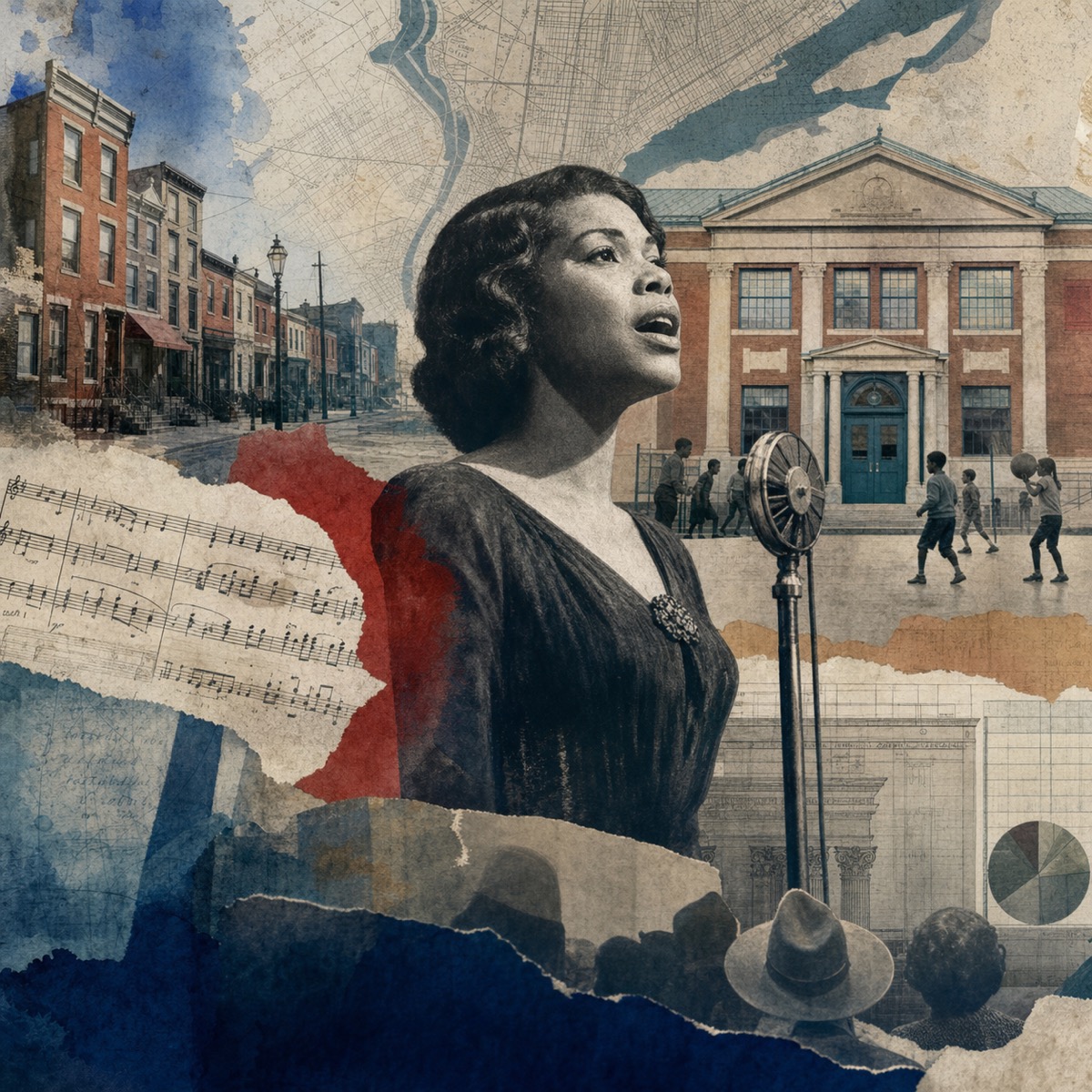
In the Philly Tours route database, two stops carry Marian Anderson’s name: her childhood home on Delancey Street in West Philadelphia and the Marian Anderson Recreation Center in Graduate Hospital. That pairing is a quiet reminder that “culture” isn’t only what happens in elite halls. It’s also what happens in neighborhoods—in schools, churches, libraries, parks, and rec centers—when public institutions give people a stage.
Anderson (1897–1993) is remembered as one of America’s great contraltos, but her deeper story is civic. It’s about how a nation decides who gets access to the spaces that confer legitimacy: where you can perform, who can attend, and what counts as “public.”
Marian Anderson’s fore-story: when a public space becomes a public stage
In 1939, the Daughters of the American Revolution barred Anderson from singing at Constitution Hall in Washington, D.C., because the organization would not allow an integrated audience. The denial backfired into a national lesson. With support from allies—including Eleanor Roosevelt—Anderson performed outdoors on the steps of the Lincoln Memorial on Easter Sunday, April 9, 1939, before a massive crowd. The National Park Service’s history pages treat the concert as part of the Lincoln Memorial’s civic story, not just a music milestone. (NPS: Marian Anderson; NPS: Marian Anderson and Constitution Hall)
That location mattered. The Lincoln Memorial wasn’t “neutral”; it was a federal public space whose meaning was already tied to national ideals. By standing there, Anderson turned access into a public question. She made a point that still holds in American civic life: when an institution denies you a room, a city (or nation) can choose to open a plaza instead—and the choice tells you what a society thinks it owes its people.
The civic bridge: public buildings decide whose voices get amplified
Philadelphia’s modern version of that question is not only about concert stages. It’s about where young people learn to speak, sing, read, debate, and build skills in the first place.
Rec centers are sometimes treated as “extras,” like optional amenities in good budget years. But in practice, they’re civic infrastructure—like transit shelters, libraries, or school gyms. They host after-school programs and summer camps. They offer safe indoor space when the weather turns dangerous. They provide classrooms for dance, music, and tutoring, and they make room for community meetings where neighbors argue, organize, and sometimes reconcile.
In other words: they are neighborhood stages. Not always literal stages with curtains and lights—but places where a public life becomes possible.
That’s why Marian Anderson is a useful guide for a present-day argument about funding. Her story isn’t only “a great artist overcame discrimination.” It’s also a reminder that public institutions create the conditions for excellence—and that exclusion and neglect are policy choices, not natural facts.
Current context: Philadelphia’s arts funding and “state of repair” politics
On the arts side, WHYY recently reported that City Councilmembers Isaiah Thomas and Rue Landau wanted Philadelphia’s FY2026 budget to allocate $6 million for arts funding—framing arts and culture as public value rather than private luxury. The same report notes that in 2025, the city allocated $4.2 million for the arts. (WHYY: Philly budget 2026 arts funding)
On the buildings side, Philadelphia’s Rebuild program describes itself as a long-term capital effort: the city says Rebuild is investing over $500 million across 72 parks, recreation centers, and libraries. (City of Philadelphia: Rebuild project sites)
The Marian Anderson Recreation Center is one of those listed project sites. (City of Philadelphia: Marian Anderson Recreation Center (Rebuild)) And Rebuild’s own progress reporting (as of April 1, 2025) listed the site in “Administrative & Pre-Design,” a phrase that reads bureaucratic but points to a real civic truth: major public reinvestment takes years, and it moves at the speed of procurement, design, and funding. (Rebuild Progress Report (PDF))
Put those threads together and you get a modern version of Anderson’s 1939 lesson. In a democracy, access isn’t only about whether you’re allowed in the room. It’s also about whether the room exists, whether it’s maintained, and whether ordinary people can use it without needing private money or special connections.
What Marian Anderson teaches about today’s choices
Marian Anderson didn’t ask for special treatment. She asked to sing. The refusal revealed how a gatekeeping institution could shrink the public. The response—moving the concert to a national public space—showed how another institution could widen it.
Philadelphia’s decisions about arts funding and rec-center reinvestment are not identical to that story, but they rhyme with it. When the city funds arts, it decides that culture belongs to everyone, not only to those who can pay. When the city repairs and modernizes rec centers, it decides that neighborhood life deserves durable places—safe, accessible, and dignified.
And when the city doesn’t fund those things, it also makes a decision: it pushes culture toward private venues, pushes youth programs toward scarcity, and makes “public life” more dependent on what individual families can afford.
If you want a practical definition of civic equality, start here: Do we maintain the buildings where people become confident enough to be heard?
Route connection: find the story on the Philly Tours map
On Philly Tours’ Black American Legacy & Quaker Heritage route, the stop at 3911 Delancey Street anchors Anderson’s Philadelphia roots. On the Black American Sports route, the Marian Anderson Rec Center (740 S 17th St.) links her name to a different kind of stage: the neighborhood public building where young people train, gather, and grow.
If you visit either stop, look past the plaque-level story and notice the infrastructure-level one. Marian Anderson’s life demonstrates that a city’s cultural greatness is never only a talent story. It’s also a building story—and a budget story—about whether we keep the public places where excellence is allowed to emerge.