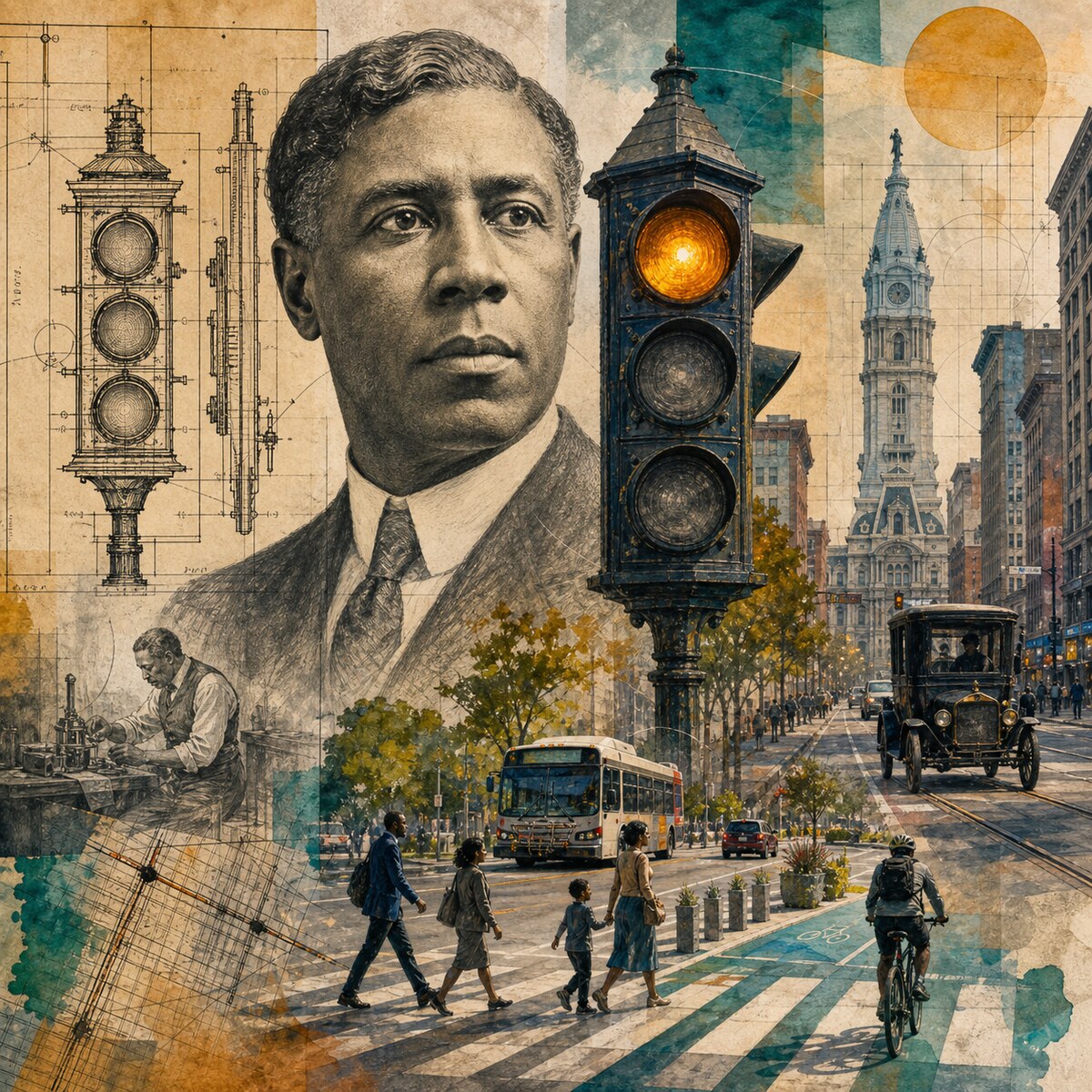
In the Philly Tours route database, one stop on the Black Inventors Tour is titled “Garrett Morgan Traffic Signal” at S 13th Street & Market Street. It’s easy to pass a traffic light without thinking about it. But Garrett Morgan’s story is a reminder that everyday street hardware can be a moral argument—an attempt to make public life less deadly, more orderly, and more fair.
Morgan (1877–1963) was an American inventor and entrepreneur whose work included a safety hood (a precursor to a gas mask) and, in 1923, an “improved” traffic signal that introduced a simple but powerful idea: an in-between moment. Not just “stop” and “go,” but a third phase that creates a safety interval—time for people to clear an intersection before the next movement begins. The U.S. Patent Office granted Morgan a patent for his traffic signal on November 20, 1923. (USPTO: “Of courage and caution”; FHWA history feature)
Morgan’s design was not the first traffic signal in America, and it wasn’t identical to the modern red-yellow-green standard. But the civic lesson holds: if you want safety at city scale, you don’t rely only on perfect behavior. You build systems that anticipate human error and reduce its consequences.
That is also the central promise—still unfinished—behind Vision Zero.
Morgan’s fore-story: safety is designed, not wished
Traffic collisions are often framed as individual mistakes: someone was distracted, someone took a risk, someone was unlucky. Morgan’s invention pushes against that framing. It treats safety as designable, which means it’s also governable.
The “caution” interval is a tiny public policy. It’s a decision made by a city (or a state) about how to allocate time and space. It’s the difference between an intersection that assumes perfect timing and one that admits the real world: people misjudge speed, drivers get impatient, pedestrians hesitate, buses need room, seniors walk slower, kids sprint unpredictably, cyclists wobble, rain reduces visibility.
You can think of Morgan’s signal as a question posed to every city that uses it:
If a little extra time can prevent a crash, why wouldn’t we give the street that time?
Civic bridge: traffic safety is a public-health system
The United States now has more than a century of traffic engineering behind it—and still loses an enormous number of people to preventable roadway deaths.
The National Highway Traffic Safety Administration (NHTSA) estimates that 39,345 people died in traffic crashes in 2024 in the United States. (NHTSA press release, April 8, 2025) Those totals include drivers and passengers, but they also include people who are unprotected by a vehicle body: pedestrians, cyclists, and motorcyclists.
In 2024, 7,080 pedestrians were killed in traffic crashes nationwide, and on average a pedestrian died every 74 minutes. (USDOT Traffic Safety Marketing / NHTSA facts)
At that scale, traffic safety stops being a niche “transportation” topic. It becomes a public-health system and a local-government test:
- Do street designs actually lower speeds where crashes are most common?
- Do enforcement tools focus on the behaviors most linked to fatal harm?
- Do capital budgets reflect where injuries happen, not only where complaints are loudest?
- Do safety improvements reach neighborhoods that have historically carried higher risk?
That’s where Morgan’s idea—the built safety interval—meets modern city governance.
Current context: what Philadelphia is doing (and measuring)
Philadelphia’s Vision Zero program is explicit about using data to focus attention on where danger concentrates.
In a November 2025 press release, the City of Philadelphia announced the Vision Zero Action Plan 2030, describing it as part of Mayor Cherelle L. Parker’s March 2024 executive order committing to eliminate traffic deaths on city streets. The release also describes a “High Injury Network”—a subset of streets where severe harm clusters—and notes that people walking, biking, or riding motorcycles accounted for nearly two-thirds of fatalities in 2024, despite being involved in less than 10% of crashes. (City of Philadelphia press release, Nov. 25, 2025)
One policy tool that sits at the intersection of “design” and “governance” is automated speed enforcement.
In February 2024, the City of Philadelphia explained that Governor Josh Shapiro signed HB 1284 in December 2023, reauthorizing speed cameras on Roosevelt Boulevard and allowing expansion to five additional corridors, along with a pilot for school-zone automated speed enforcement. The city’s announcement also cites results from its Vision Zero reporting and research analysis, including large reductions in speeding violations and serious crashes on Roosevelt Boulevard after cameras went live. (City of Philadelphia, Feb. 21, 2024)
In February 2026, PennDOT announced a $13 million investment in traffic-safety projects in Philadelphia funded through the automated speed enforcement program, describing it as support for projects aligned with safer travel for people driving, walking, biking, and taking transit. (PennDOT press release PDF, Feb. 11, 2026)
Those announcements are not “solutions” by themselves. But they show the shape of a modern Vision Zero approach: treat traffic deaths as a measurable, preventable public outcome; focus on a known network of high harm; and fund interventions that can be evaluated over time.
This is where Morgan is useful as more than a history fact.
Morgan’s three-position signal wasn’t only clever engineering. It was a public claim that the street is not a wilderness where the fastest wins. A city can set rules, redesign space, and standardize safety—so that ordinary errands don’t carry extraordinary risk.
The takeaway: a caution interval for democracy
There is a temptation in civic life to treat preventable deaths as background noise. That’s what “accident” language can do: make harm feel inevitable and nobody’s responsibility.
Vision Zero, at its best, is the opposite. It is a civic refusal to accept preventable death as the price of mobility. It asks local government to do the unglamorous work of:
- collecting clean data,
- focusing investments,
- coordinating agencies,
- changing street geometry,
- updating signal timing,
- enforcing high-risk behavior consistently,
- and reporting progress publicly.
Seen that way, Morgan’s invention becomes a metaphor for what public institutions owe residents: the safety interval that makes life survivable when someone makes a mistake.
Route connection: look at 13th & Market differently
When you reach the Garrett Morgan Traffic Signal stop on the Black Inventors Tour, look around the intersection. Notice who has the most stress: a pedestrian trying to cross before the signal changes, a bus negotiating a turn, a cyclist trying to stay visible, a driver impatient with congestion.
Then ask a Morgan-style question of the present:
If we know where people are getting hurt—and we know what reduces injury—are we building the “caution interval” into the city on purpose?
Philadelphia’s Vision Zero work suggests the city is trying to answer that question with data, corridor-by-corridor investments, and accountability. The lesson from Garrett Morgan is that this kind of safety isn’t a vibe. It’s a design choice—and a budget choice—that a city has to keep making.
Sources: USPTO: “Of courage and caution” (Garrett Morgan), FHWA: Garrett Morgan traffic signal legacy, NHTSA 2024 traffic fatalities estimate, USDOT/NHTSA pedestrian fatality facts, Philadelphia Vision Zero Action Plan 2030 release, Philadelphia automated speed enforcement renewal/expansion, PennDOT ASE investment in Philadelphia (PDF).