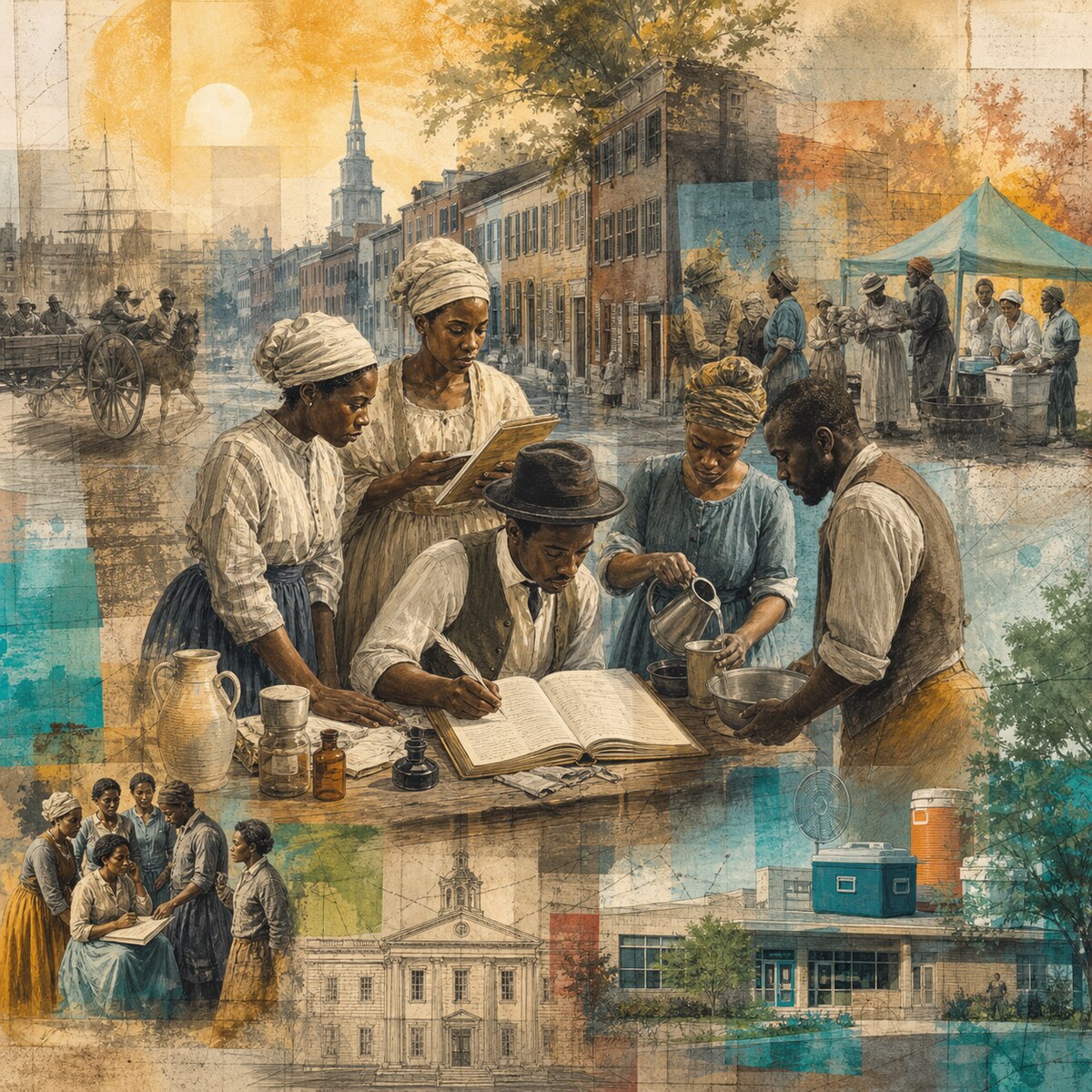
In Philly Tours’ route database, the Free African Society stop is tied to a foundational Philadelphia story: how an organized Black mutual-aid institution stepped into public-health work during the 1793 yellow fever epidemic, when the city’s formal systems were overwhelmed.
That fore-story matters in 2026 because Philadelphia faces another recurring public-health emergency that tests the same “last mile” of civic capacity: extreme heat.
Fore-story: mutual aid became emergency response in 1793
The Free African Society (FAS) formed in 1787 as a nondenominational mutual-aid society led by Richard Allen and Absalom Jones—a way to pool resources, support members, and build durable institutions in a city that offered free Black residents limited security. The Encyclopedia of Greater Philadelphia describes the FAS as the first mutual-aid society dedicated to serving Philadelphia’s growing free Black community.
When yellow fever struck in 1793, that structure turned into a public assignment. The U.S. National Park Service notes that the 1793 Philadelphia epidemic was the most horrific yellow fever outbreak in North America, with more than 5,000 deaths.
The FAS’s work during the epidemic is often remembered as moral courage. It should also be remembered as organization: recruiting volunteers, coordinating care, and sustaining response while fear, rumor, and scarcity made everything harder. And it included a fight over public credibility. The Park Service preserves Allen and Jones’ 1794 pamphlet, A Narrative of the Proceedings of the Black People, During the Late Awful Calamity in Philadelphia, in the Year 1793, written in part to refute accusations thrown at Black caregivers after the crisis.
Public health, in other words, was never only medicine. It was also trust: who is believed, who is blamed, and whose work is treated as legitimate.
Civic bridge: the “last mile” is where emergencies are won or lost
Philadelphia in 1793 and Philadelphia in 2026 do not face the same disease or the same institutions. But emergencies still expose the same gap: the distance between a plan announced centrally and the moment a resident needs help—on a hot block, in an overheated rowhouse, or in a crowded shelter.
That “last mile” depends on simple things that are not simple to deliver at scale: clear information, reachable help, and people on the ground who can connect neighbors to resources.
Current context: Philadelphia’s heat-health emergency playbook
Heat is not a side issue. The U.S. Environmental Protection Agency describes heat as already the leading weather-related cause of death in the United States, and the CDC explains that extreme heat events are becoming more frequent and intense and can drive illness and death.
Philadelphia has a specific public tool for that reality: the Heat Health Emergency declaration. In a 2025 explainer, the Philadelphia Department of Public Health describes what a heat-health emergency activates, including a Heatline where residents can get tips and talk to medical professionals. A June 20, 2025 City press release describing a Heat Health Emergency also highlights the shape of response: cooling options, home visits by special field teams, and enhanced outreach for people experiencing homelessness.
The civic lesson is what these programs acknowledge: heat becomes deadly through housing quality, chronic health conditions, isolation, and the plain absence of a cool place to go. So response has to be distributed, too—not just hospital care, but phone lines, outreach, places to sit, and instructions that people will actually trust and use.
Neighborhood access: resource hubs as modern public-health infrastructure
On May 4, 2026, the Philadelphia Department of Public Health announced it is expanding Resource Hubs by relocating them into Neighborhood Community Action Centers, with the goal of growing from four sites to up to ten over time. The press release describes Resource Hubs as starting during the COVID-19 response, then evolving into trusted neighborhood access points for a wider range of public-health resources.
This is the same basic design insight the Free African Society embodied: help is only as real as the path to it. If the tools are too far away, too confusing, or too stigmatized to use, the plan fails—especially during an emergency season.
Who does the work: a volunteer bench for public health
In 1793, the Free African Society mobilized because it had already built a membership structure and a culture of obligation. Modern public health tries to build some of that readiness in advance, in a way that is organized, trained, and accountable.
Philadelphia’s Medical Reserve Corps is one example. The City describes it as a group of more than 5,000 volunteers, coordinated by the Department of Public Health, who can support response during public-health emergencies and large-scale events. Nationally, the U.S. Department of Health and Human Services describes the Medical Reserve Corps as a network of local units that strengthen preparedness, response, and recovery.
The bridge from 1793 to 2026 is not the identical details of a crisis. It is the basic truth that preparedness is partly a staffing plan: you cannot improvise trust, training, and coordination overnight.
Route connection: seeing the public-health city in place
On Philly Tours’ Black Medical Legacy stops, you can stand near the Free African Society location on Lombard Street and feel how close the past is to the present tense. The distance is short between that mutual-aid story and the city’s modern emergency systems. The question is whether the systems are usable when they’re needed.
The Free African Society’s lesson is not nostalgia. It is a civic standard: in emergencies, organized care is a form of public power—and it works best when it is built where people live, not only where institutions are headquartered.
Sources: Free African Society (Encyclopedia of Greater Philadelphia), Yellow Fever (U.S. National Park Service), Allen & Jones pamphlet (NPS), EPA on extreme heat, CDC on temperature extremes, Philadelphia heat health emergency explainer, Philadelphia Heat Health Emergency press release (June 20, 2025), Resource Hubs expansion press release (May 4, 2026), Philadelphia Medical Reserve Corps, HHS Medical Reserve Corps.