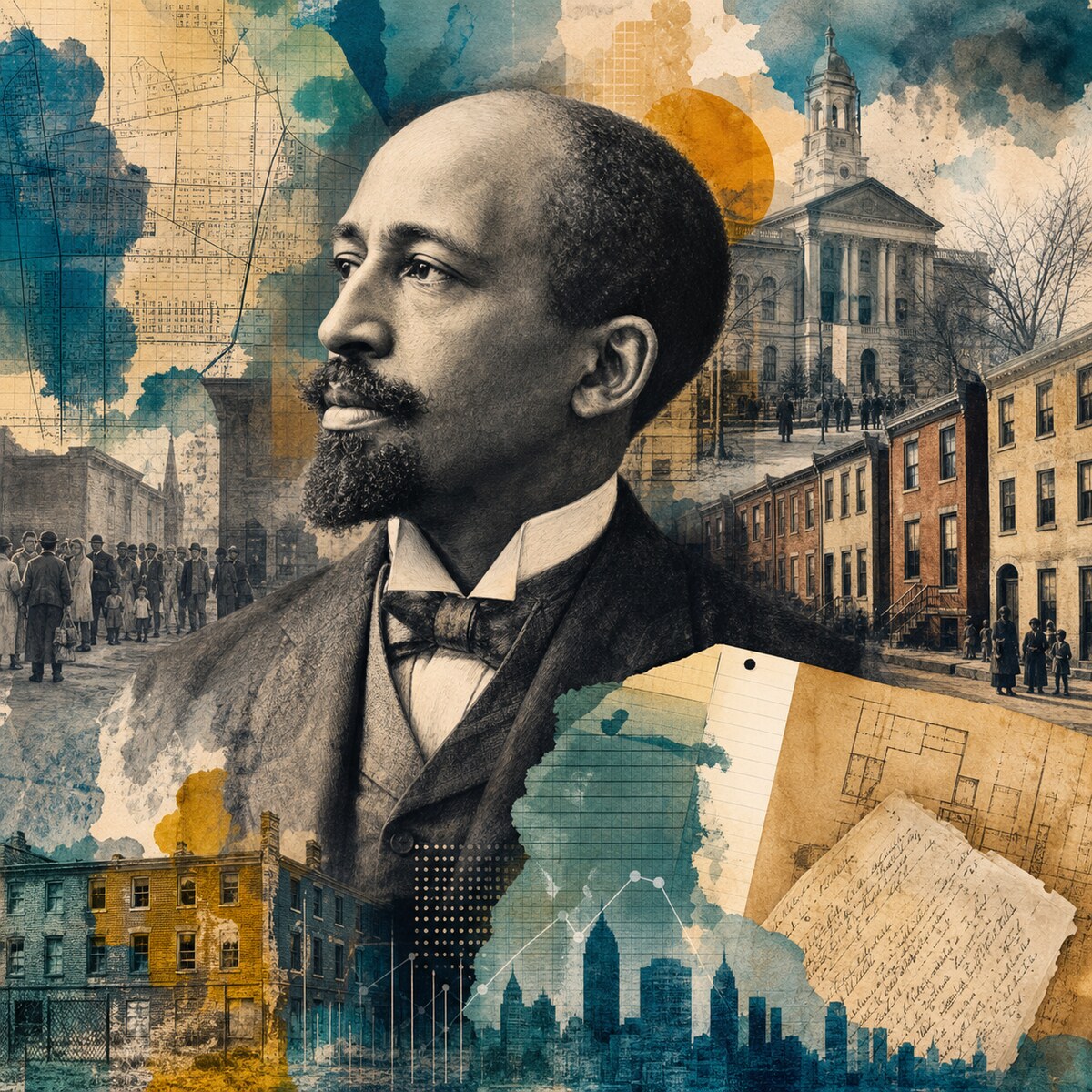
In the Philly Tours route database, one stop is titled “W.E.B. Du Bois College House”—a quiet reminder that one of America’s most influential public intellectuals did some of his most grounded work in Philadelphia. The exhibit referenced there points to The Philadelphia Negro (1899), Du Bois’s landmark, data-driven study of life in the city’s Seventh Ward.
Du Bois did not write a travelogue. He built a public record. He knocked doors, mapped blocks, compiled household surveys, and turned neighborhood conditions into evidence that a city could not ignore. The core lesson was not just that inequality existed, but that it could be measured, explained, and confronted as a civic choice.
That lesson is newly relevant in 2026—not because we lack “data” today, but because we still struggle to decide what to do with it.
Philadelphia’s present-day housing system creates data at every step: a rent ledger, a licensing database, a diversion portal, a court docket. The question is whether that information helps prevent displacement, or merely documents it.
Du Bois’s fore-story: data as a moral instrument
Du Bois approached Philadelphia with an argument that still feels modern: social conditions are shaped by institutions, labor markets, housing, and public decisions—not by myths about who “deserves” stability. Data was his tool for replacing folklore with a public-policy diagnosis.
He also understood something else that modern dashboards can obscure: numbers do not enforce themselves. Data has to be tied to institutions that can act, and to rights that can be used by regular people.
If you want a contemporary parallel, look at eviction.
Civic bridge: eviction is not only a private dispute
Eviction is often talked about as a landlord-tenant conflict. But at city scale, it becomes infrastructure: a pathway that moves families, reshapes school enrollment, changes neighborhood composition, and affects public costs (shelter, health care, emergency services). It is a government concern because the process runs through government: courts, enforcement, housing codes, and public benefits.
And just like in Du Bois’s Philadelphia, the burden is not distributed evenly. Whether a renter keeps their home can depend on paperwork, timing, knowledge of procedure, and—crucially—whether anyone is there to translate rights into action.
That is why “Right to Counsel” has become one of the most important housing policies in Philadelphia.
Current context: what Philadelphia is doing in 2026
In late April 2026, the City of Philadelphia announced an expansion of its Right to Counsel (RTC) initiative for eligible tenants facing eviction, adding new ZIP codes and bringing covered areas to ten total. The city says ZIP codes were selected based on need using analysis by the Reinvestment Fund, and that RTC eligibility is tied to income at or below 200% of the federal poverty level. citeturn2view2
The same announcement makes a claim worth pausing on: together with related programs (Philadelphia Eviction Prevention Project services and the Eviction Diversion Program), Philadelphia reports eviction filings are down 35–40% from pre-pandemic levels, and that RTC now covers more than 43% of renters facing eviction. citeturn2view2
Philadelphia also publishes annual reporting on Right to Counsel. In its Fiscal Year 2025 annual report (covering July 1, 2024 through June 30, 2025), the city reports that 1,754 households in RTC ZIP codes received legal representation or legal advice from program partners across venues. citeturn2view0
These numbers are not a victory lap; they are a window into what a city can build when it treats housing stability as a public concern rather than an individual failing.
Why “diversion” matters (and what the data says)
Right to Counsel is only one piece of Philadelphia’s eviction-prevention architecture. Another is the Eviction Diversion Program (EDP), which pushes cases toward negotiation, rental assistance pathways, and mediation before they become court filings.
The city has also evaluated this work. A city-published evaluation of eviction diversion describes how the program routes cases through an online portal, tenant support, and mediation partners, then examines whether diversion activity reduces or prevents municipal court filings. It reports that outcomes varied by phase as volumes and conditions changed, but also that reaching agreements was associated with lower filing rates in both phases analyzed. citeturn2view1
That kind of analysis is Du Bois–like in spirit: the city is trying to learn from its own administrative reality, not just assert that a program “helps.” But the evaluation also hints at a hard truth: systems can be effective and still fall short at scale, especially as economic pressure rises and caseloads grow.
The public-policy lesson Du Bois offers in 2026
Du Bois’s Seventh Ward work teaches a specific kind of civic humility. Data does not let a city off the hook. It asks the city to decide, openly, what it will do.
In housing policy, that means asking questions that are more practical than ideological:
- If we can identify ZIP codes with high eviction risk, are we funding legal help and housing counseling before the court date?
- If we can measure default judgments, are we building a process where “missing a hearing” is not the same as “losing your home”?
- If we see cases concentrate by property, owner, or attorney, are we treating eviction as a pattern in need of oversight, not only a series of isolated disputes?
Philadelphia’s Right to Counsel expansion signals a philosophy: when the city knows where the harm concentrates, it has a responsibility to put real capacity in the hands of residents—especially the capacity to be heard.
That is not abstract fairness. It is due process as housing policy.
Route connection: a stop that changes how you see the city
Philly Tours includes Du Bois because his story is not only about a famous name. It is about method—about looking at Philadelphia closely enough to tell the truth, and then asking what the truth requires of public life.
When you encounter the Du Bois stop on the Black American Legacy & Quaker Heritage route, treat it as a prompt for the rest of the city. Philadelphia is still living with the question Du Bois posed in 1899: will we use evidence to build a more stable, more fair civic order—or will we merely keep recording instability as if it were inevitable?
Sources: City of Philadelphia Right to Counsel expansion press release (April 2026), Right to Counsel FY2025 annual report (PDF), Eviction Diversion in Philadelphia evaluation (PDF).