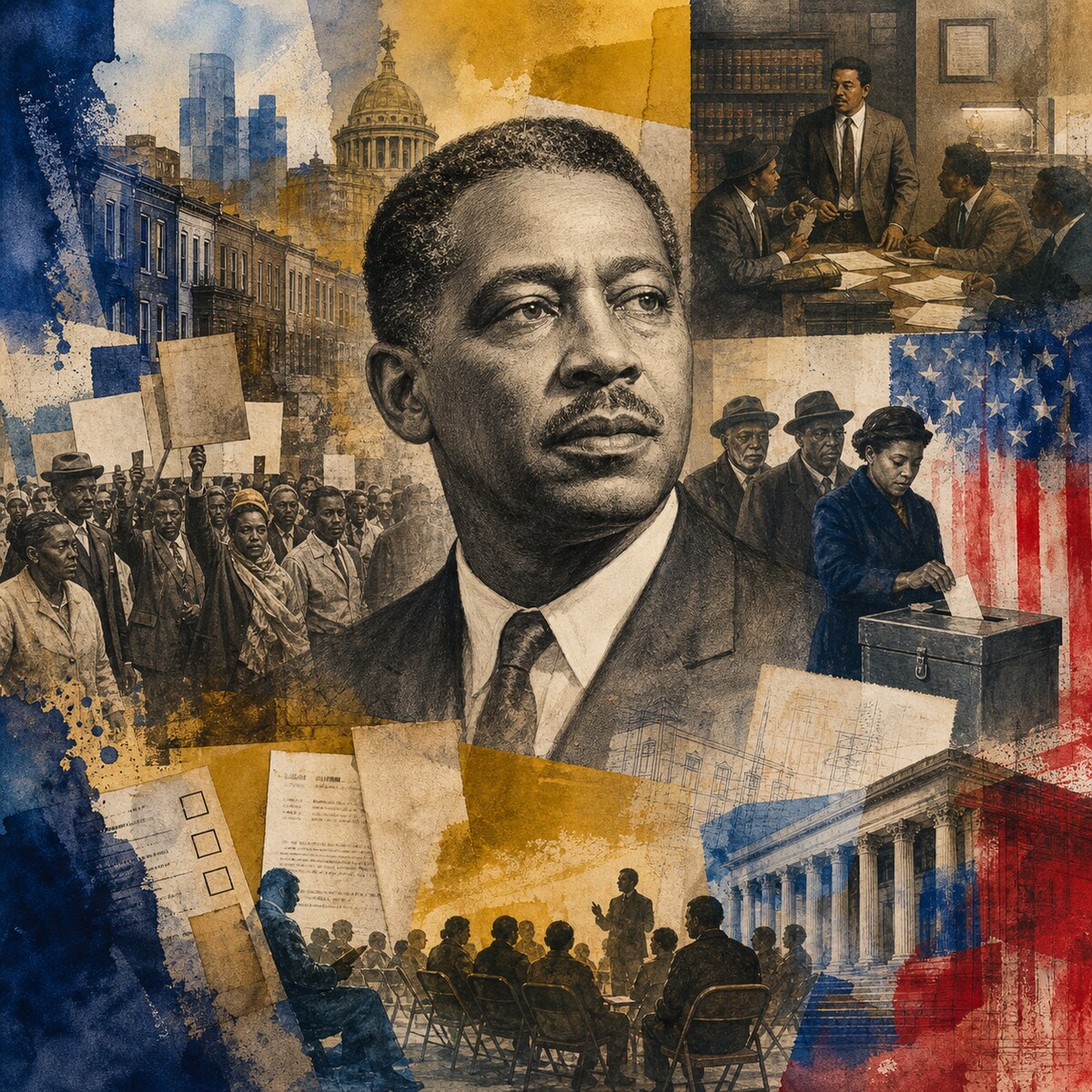
Cecil B. Moore is not only a name on an avenue in North Philadelphia. In the Philly Tours route database, he appears through stops tied to civil rights organizing, law, protest, and political power: Cecil B. Moore Avenue, the Cecil B. Moore Law Office, and the Cecil B. Moore Mural.
That matters because Moore's story was never just about memory. It was about access. Access to schools. Access to jobs. Access to public resources. Access to political representation. And, underneath all of that, access to the vote.
Moore was a lawyer, a former Marine, a Philadelphia NAACP leader, and a city councilmember. His work pushed civil rights out of polite ceremony and into daily public pressure. He understood that democracy is not only what a law says on paper. It is what people can actually use when they stand at the door of an institution, a school, a courtroom, a union hall, or a polling place.
That is why his legacy is useful in 2026, as voting rules remain a live political fight across the United States.
The old question inside the new debate
The current argument over voting is often presented as a fight between election security and voter access. One side emphasizes citizenship verification, list maintenance, and confidence in election systems. The other warns that new paperwork rules, purges, or administrative burdens can keep eligible voters from participating.
The federal government still describes voting rights as protected by constitutional amendments and laws including the Voting Rights Act, the National Voter Registration Act, the Help America Vote Act, and protections for military and overseas voters. USAGov's voting-rights overview notes that American voting access has been shaped by amendments, federal law, and the long history of barriers such as literacy tests and other restrictions on Black voters. The Department of Justice Voting Section says it enforces federal civil voting-rights laws, including the Voting Rights Act, the National Voter Registration Act, and the Help America Vote Act.
Those are not abstract laws. They are the modern legal architecture built after generations of exclusion.
In March 2026, the White House issued an executive order focused on citizenship verification and election integrity in federal elections. In April 2026, the Justice Department announced federal lawsuits against five states over voter-registration list maintenance. These are current events, but the deeper political question is older: when government changes voting rules, who gains confidence, who gains access, and who carries the burden?
That is a Cecil B. Moore question.
Moore's politics were about usable rights
Moore's public life in Philadelphia was shaped by the idea that rights have to become practical. A right that exists but cannot be reached is not enough. A school that claims fairness while excluding Black children is not enough. A city that praises democracy while leaving Black residents without equal political power is not enough.
That same test belongs in today's voting debate.
If a rule is meant to protect elections, it should be judged not only by its stated purpose but by how it lands on real voters. Does it make registration clearer or more confusing? Does it improve trust without blocking eligible citizens? Does it account for people who move often, work hourly jobs, lack easy document access, serve in the military, live with disabilities, or rely on community groups for registration help?
Moore would likely recognize the pattern: public systems often sound neutral until you ask who has to spend extra time, money, paperwork, and risk to use them.
Philadelphia as a classroom
Philadelphia is a good place to ask these questions because the city holds so many layers of American democracy. It is a founding-era city, a Black organizing city, a labor city, a migration city, a civil-rights city, and a neighborhood-politics city.
Cecil B. Moore's North Philadelphia legacy sits inside that larger story. The streets, murals, offices, and institutions tied to him remind us that voting rights were never separate from education, housing, policing, employment, and public funding. Political access decided who could influence all of it.
That is the bridge from past to present: the ballot is not only a symbol. It is a tool for deciding whose problems become public priorities.
What the present can learn from the fore-story
Moore's story does not give an easy answer to every election-policy fight in 2026. It gives a sharper way to ask the questions.
Election security matters. Public trust matters. Accurate voter rolls matter. But access matters too, especially in a country where access has been denied through law, custom, intimidation, paperwork, and selective enforcement.
The lesson from Moore's Philadelphia is that democracy has to be measured at street level. Not only by what officials announce, but by what residents can actually do.
When a voter walks into a registration office, checks a deadline, updates an address, waits in line, corrects an error, or proves eligibility, that is where democracy becomes real. The question is whether the system treats that person as a participant to be served or a problem to be managed.
That question is why Cecil B. Moore still belongs in a conversation about current events and politics. He helps us remember that voting rights are not a chapter that closed. They are a public responsibility that keeps coming back for another test.
Sources: USAGov voting rights, Department of Justice Voting Section, White House executive order on federal elections, City of Philadelphia Black History Month profile.